

New to the races? Racing has a language of its own. This guide covers the words and phrases you might hear at Pinjarra Park, in the racebook and from the race caller.
Around the track
- Barriers (the gates) The starting stalls. A horse's barrier number is the stall it starts from, counted from the inside rail.
- Birdcage The enclosure where horses are stabled and saddled on race day.
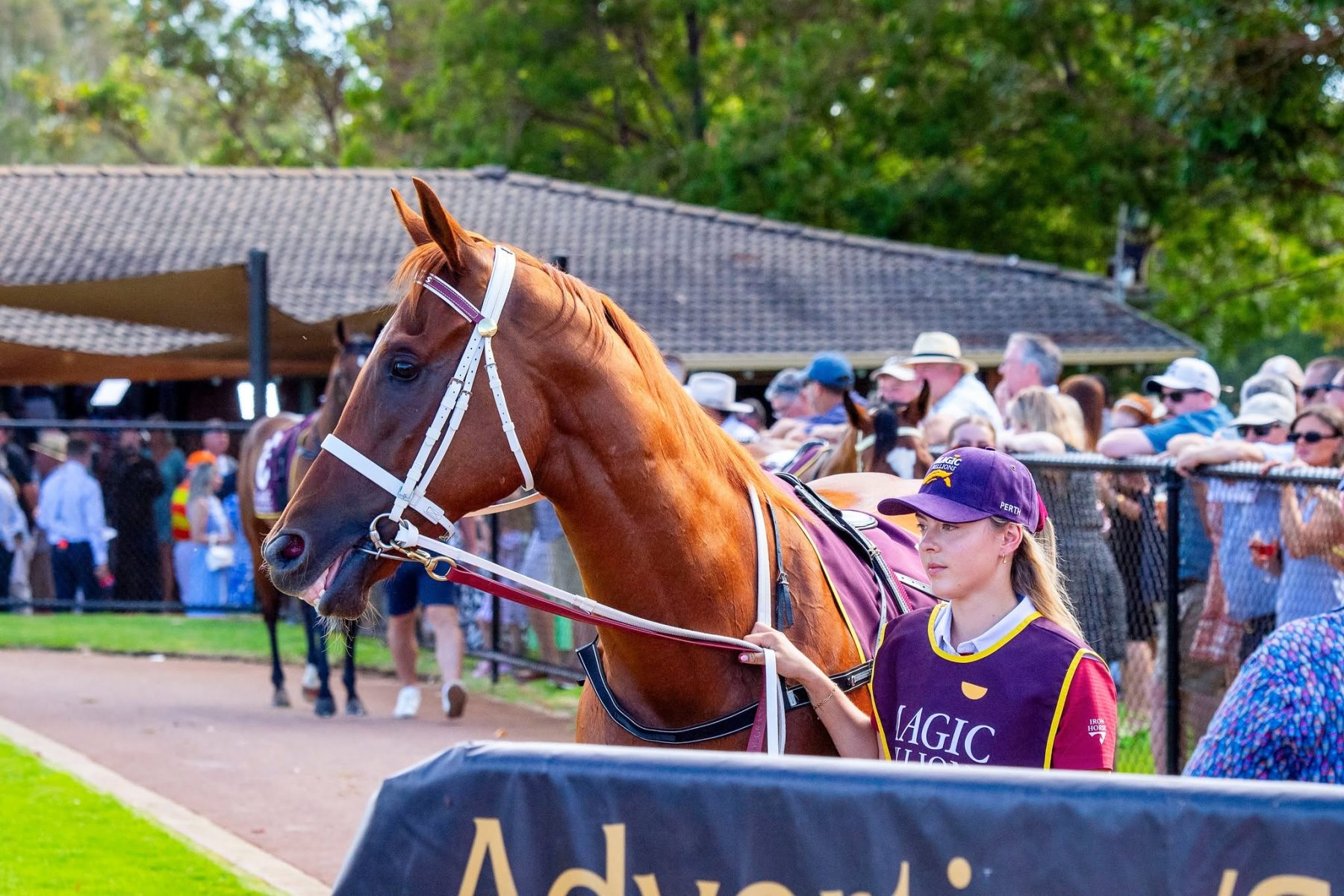
- Mounting yard Where horses parade before a race and jockeys get on. It's the best place to look over the field.
- The rail The fence on the inside of the track. "Rail out 3 metres" means it has been moved out to give horses fresh ground.
- The straight The final run to the winning post after the home turn.
- Winning post The finish line.
- Betting ring Where the on-course bookmakers stand.
- Racebook The race day program, with every runner, jockey, trainer, set of colours and form.
The people
- Jockey The rider.
- Apprentice A jockey still learning the trade. Apprentices "claim", which means their horse carries less weight (around 1.5 to 4 kg less). The claim reduces as they ride more winners.
- Trainer Trains and prepares the horse.
- Strapper Looks after the horse and leads it around the mounting yard.
- Connections The owners and trainer of a horse.
- Stewards The officials who govern racing activities on race day.
- Clerk of the course The mounted official who leads the field to the start and catches loose horses.
- Bookmaker (bookie) A licensed person who takes bets at defined odds.
- Punter Anyone having a bet. Professional or Career Punters usually make a living off betting, and often have their own method of picking a winner.
The horses
- Colt A male horse aged three or under that has not been gelded.
- Filly A female horse aged three or under.
- Mare A female horse aged four or over.
- Gelding A castrated male horse.
- Horse (or entire) An ungelded male aged four or over.
- Sire and dam A horse's father and mother.
- Birthday Every racehorse in Australia turns a year older on 1 August, whatever day it was born.
- Maiden A horse that has not yet won a race.
- Sprinter & stayer A horse best suited to short races (up to about 1200 m), whereas a stayer is more suited to 2000 m and beyond.
- Mudlark A horse that runs well on a wet track.
- Favourite The horse with the shortest odds.
- Roughie An outsider at long odds.
- Colours (or silks) The jacket and cap the jockey wears, registered to the owner.
- Gear Equipment such as blinkers, which narrow a horse's vision to keep its focus on the job. Gear changes are listed in the form guide.
Before the race
- Nominations and acceptances Horses are first nominated for a race, then "accepted" to form the final field.
- Barrier draw The draw that gives each horse its starting stall.
- Scratching A horse withdrawn from a race. A late scratching is one withdrawn on race day or after acceptances.
- Emergency A reserve runner that gets a start only if another horse is scratched.
- Form A horse's recent record. In the form line "1x32", the horse was third, then second, had a break (x), then won; the oldest run is on the right. A "0" means it finished tenth or lower.
- First-up A horse's first run after a spell. Second-up is the run after that.
- Spell A break from racing, which can be a few weeks, months, or more.
- Handicap A race where each horse carries a weight set by the handicapper to even up the field. The best-performed horse carries the most and is the topweight.
- Weight-for-age A race where weights are set by a horse's age and sex, not its record.
- Maiden race A race for horses that have never won.
- Class 1, Class 3 and so on Races limited to horses with no more than that many wins.
- Ratings (benchmark) race A handicap for horses within a ratings band, such as 0–58 or 62+.
- Listed and Group races The best races. Group 1 is the highest level, then Group 2, Group 3 and Listed. Together they are known as "black type" races.
- Trial A practice race with no betting to prepare and/or educate the horse for a race.
- Track rating The condition of the surface, from Firm 1 and 2, Good 3 and 4, Soft 5 to 7, through to Heavy 8 to 10. Certain track conditions can favour certain horses. Track conditions can also play a role in times.
During and after the race
- The jump The start.
- On the pace Racing at or near the lead.
- Box seat The spot on the rail directly behind the leader.
- One out, one back One horse off the rail and one behind the leader, widely considered the ideal position.
- Three wide without cover Racing wide with no horse in front to shelter behind, which costs energy.
- Backmarker A horse that settles near the rear and finishes late. One that storms home is a swooper.
- Checked Forced to slow or change course because of another runner.
- Held up Unable to find clear running.
- Margins Winning distances. From smallest: nose, short half-head, half-head, head, neck, then lengths. A length is about 2.5 metres.
- Photo finish The judge uses the finish-line camera to separate the placegetters.
- Dead heat A tie. Dividends are shared.
- Weighing in After the race, the placed jockeys are weighed to confirm they carried the right weight.
- Protest An objection claiming interference affected the result. The stewards hear it and either uphold or dismiss it.
- Correct weight The official signal that the result stands. Bets are paid from this point, so hold on to your ticket until you hear it.
Having a bet
- TAB and tote The totalisator pools all bets of one type, and the final dividend depends on how much was bet on each horse. Odds fluctuate and the final payout is determined based on the closing price/price when the race starts.
- Fixed odds The price is locked in when you place the bet.
- Odds (price) Shown as the return for each $1 bet, including your stake. At $3.50, a $10 bet returns $35.
- Odds-on Shorter than $2.00. Even money is $2.00.
- Win Your horse must finish first.
- Place Your horse must finish in the first three. With five to seven runners, only first and second pay; with fewer than five there is no place betting.
- Each way An equal bet for the win and the place.
- Quinella Pick the first two in any order.
- Exacta Pick the first two in the correct order.
- Trifecta Pick the first three in the correct order.
- First four Pick the first four in the correct order.
- Boxed Covering your selections to finish in any order.
- Flexi bet Betting a smaller amount for a percentage of the dividend.
- Double Pick the winners of two nominated races.
- Quaddie Pick the winners of four nominated races.
- Starting price (SP) The official odds at the jump.
- Deductions If a horse is scratched after you take fixed odds, your payout or potential refund is reduced.
- Firmer and drifter A horse whose odds are shortening, and one whose odds are getting longer (higher).
- Plunge A sudden rush of money for one horse.
- Late mail Last-minute tips or annoucements.
Phrases you'll hear
- "A good thing" or "a moral" A horse expected to win.
- "London to a brick" Very short odds; near enough to a certainty.
- "Bolted in" Won easily.
- "Daylight second" The winner was so far in front that nothing else was close.
- "Got up on the line" Won in the last stride.
- "Home and hosed" The race is as good as won.
- "Saluted" or "got the chocolates" Won.
- "Knocked up" Tired badly in the straight.
- "On the nose" A bet to win only.
- "In the red" Odds-on.
- "A smoky" A horse with a better chance than its odds suggest.
- "Ran a drum" Performed as tipped.
- "Stone Motherless" A horse that runs last "Stone Motherless last".
Gamble responsibly. If you choose to bet, set a limit and stick to it.
